
The right all-inclusive resort is not automatically the newest, most expensive, or highest-rated property. It is the resort that fits the people traveling, the experience they want, and the details that will affect their vacation every single day.
Start with these questions:
- Who is traveling?
- What kind of atmosphere do you want?
- How important is the beach?
- What are your dining expectations?
- How will you use the room?
- How much resort walking is realistic?
- How long are you willing to spend getting there?
- What is your total vacation budget, not merely the room price?
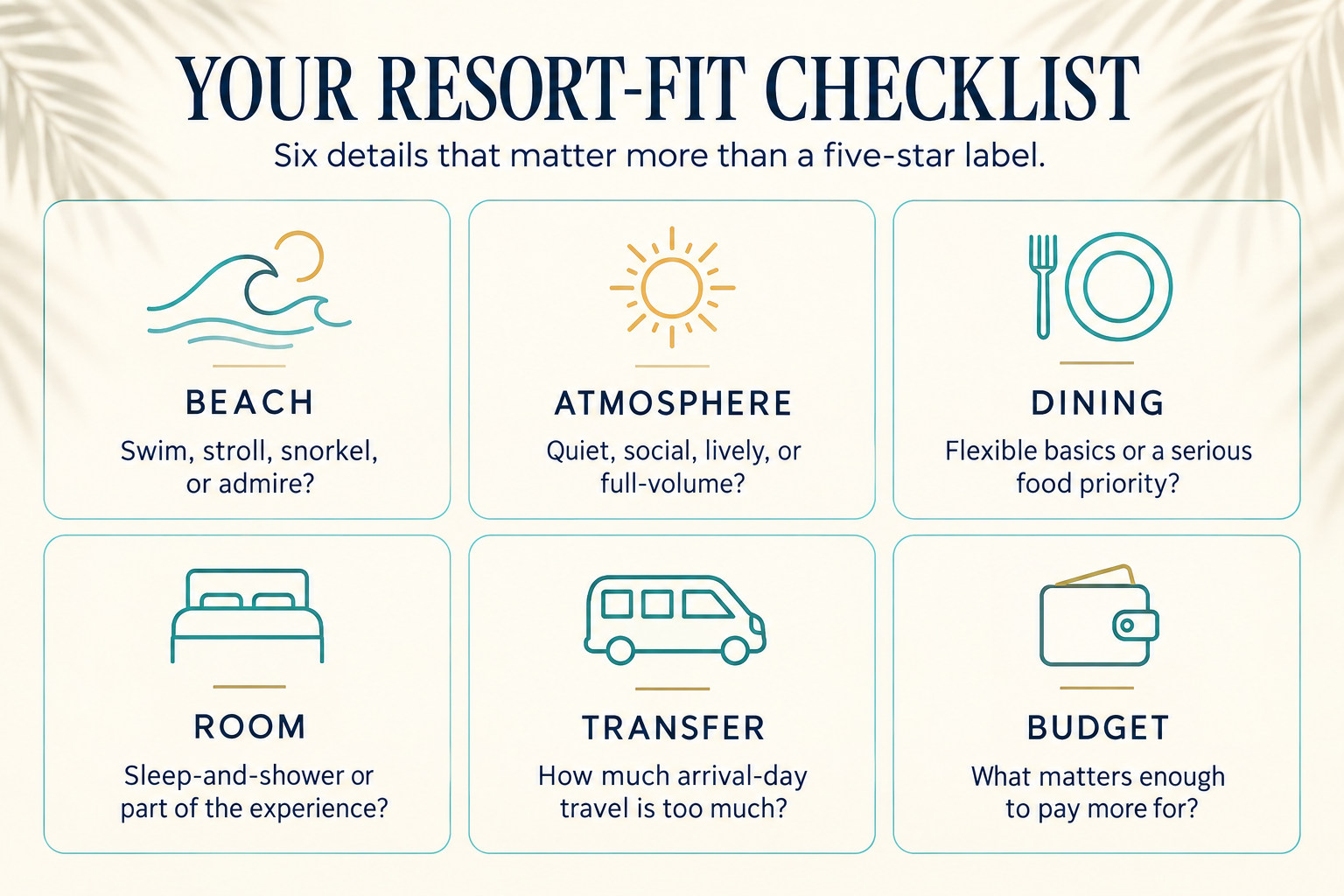
Get those answers straight first. Otherwise, you can spend three nights comparing 47 suspiciously similar resort photos and still choose the wrong place.
A resort can be very good and still be completely wrong for you.
Who is actually going on this vacation?
This sounds painfully obvious. It is also where resort matching begins.
A couple celebrating an anniversary does not need the same resort as a family traveling with two teenagers. A friends’ trip has different room and nightlife needs than a honeymoon. A multigenerational group may need elevators, shorter walking distances, flexible dining, connecting-room options, and activities that do not leave Grandma and the eight-year-old glaring at each other across the lobby.
Before looking at resorts, identify:
- The number and ages of all travelers
- Whether everyone is sharing rooms or needs separate accommodations
- Mobility or accessibility needs
- Sleeping arrangements and privacy requirements
- Dietary considerations
- The reason for the trip
- Each traveler’s nonnegotiables
The last one matters. If one person needs a calm, swimmable beach and another wants a pool party with a DJ, we need to discuss which person is about to be disappointed.
What do you want the vacation to feel like?
“Nice” is not an atmosphere.
Do you want quiet and romantic? Social but not rowdy? Family-friendly without feeling like you have moved into a preschool? Lively during the day but calm after dinner? Plenty of entertainment without a foam party appearing every time you try to read a book?
Resorts can fall anywhere from sleepy to full-volume. Size also changes the experience. A compact resort can feel easy and personal. A sprawling property may offer more pools, restaurants, activities, and places for a group to spread out, but it can also involve shuttles, long walks, and a daily expedition to breakfast.
Think about how you normally enjoy your free time. If you prefer small restaurants, quiet mornings, and knowing where everything is by the second day, an enormous resort complex may not feel luxurious. It may feel like you need a Google Maps printout and emergency provisions.
Does adults-only mean quiet and romantic?
No. Adults-only is an age policy, not a personality.
An adults-only resort can be romantic, sophisticated, social, wellness-focused, entertainment-heavy, or built around a serious party scene. Some primarily attract couples. Others work well for friends’ trips, solo travelers, or adult family groups.
An adults-focused resort is different. It may welcome children while designing much of the experience around adults. Some family resorts also have adults-only accommodations, pools, restaurants, or sections, but access rules vary.
Do not choose based on the adults-only label alone. Ask:
- What is the daytime pool atmosphere?
- What happens after dinner?
- Is the resort designed mainly for couples?
- Are adult-only areas truly separate?
- Which restaurants and facilities can each guest access?
- Does the room layout provide enough privacy for friends sharing?
A glass shower in the middle of the room may look dramatic in a photograph. It becomes considerably less charming when you are traveling with your sister.
How important is the beach?
If the beach is the main reason for the trip, treat it as a primary requirement, not a decorative item behind the pool.
Be specific about what “good beach” means to you:
- Soft sand
- Calm, swimmable water
- Room for long walks
- Natural shade
- Plenty of loungers
- Good snorkeling
- Minimal rocks
- Easy entry into the water
- A wide beach rather than a narrow strip
Those are not interchangeable.
Beach conditions can also vary with weather, currents, season, and natural events. No advisor or resort can responsibly guarantee exactly what the ocean will look like on a particular Tuesday eight months from now.
If you are primarily a pool person, say that too. The resort with the stronger pool setup, better shade, and the atmosphere you want may be the smarter choice, even if another property has the prettier beach.
What are your real dining expectations?
“Good food” means different things to different travelers.
One person wants familiar meals, a generous breakfast buffet, and something available whenever the kids become feral. Another wants thoughtful à la carte dining, good wine, strong cocktails, and enough variety to avoid repeating restaurants during a seven-night stay.
Look beyond the number of restaurants. Ask:
- Which venues are open every night?
- Are reservations required or limited?
- Are any restaurants restricted to upgraded-room guests?
- Is room service included, limited, or available only during certain hours?
- Are premium wines or certain menu items an extra charge?
- How well can the resort accommodate dietary needs?
- Are dress requirements compatible with what you actually want to pack?
- Is late-night food available?
A resort can advertise nine restaurants, but that number is less impressive if two are lunch-only, one is an upcharge, and the place you wanted most is closed half the week.
Dining schedules, menus, reservation procedures, and inclusions can change. Verify them for the specific resort and travel dates instead of relying on a review written three years ago.
How much does the room category matter?
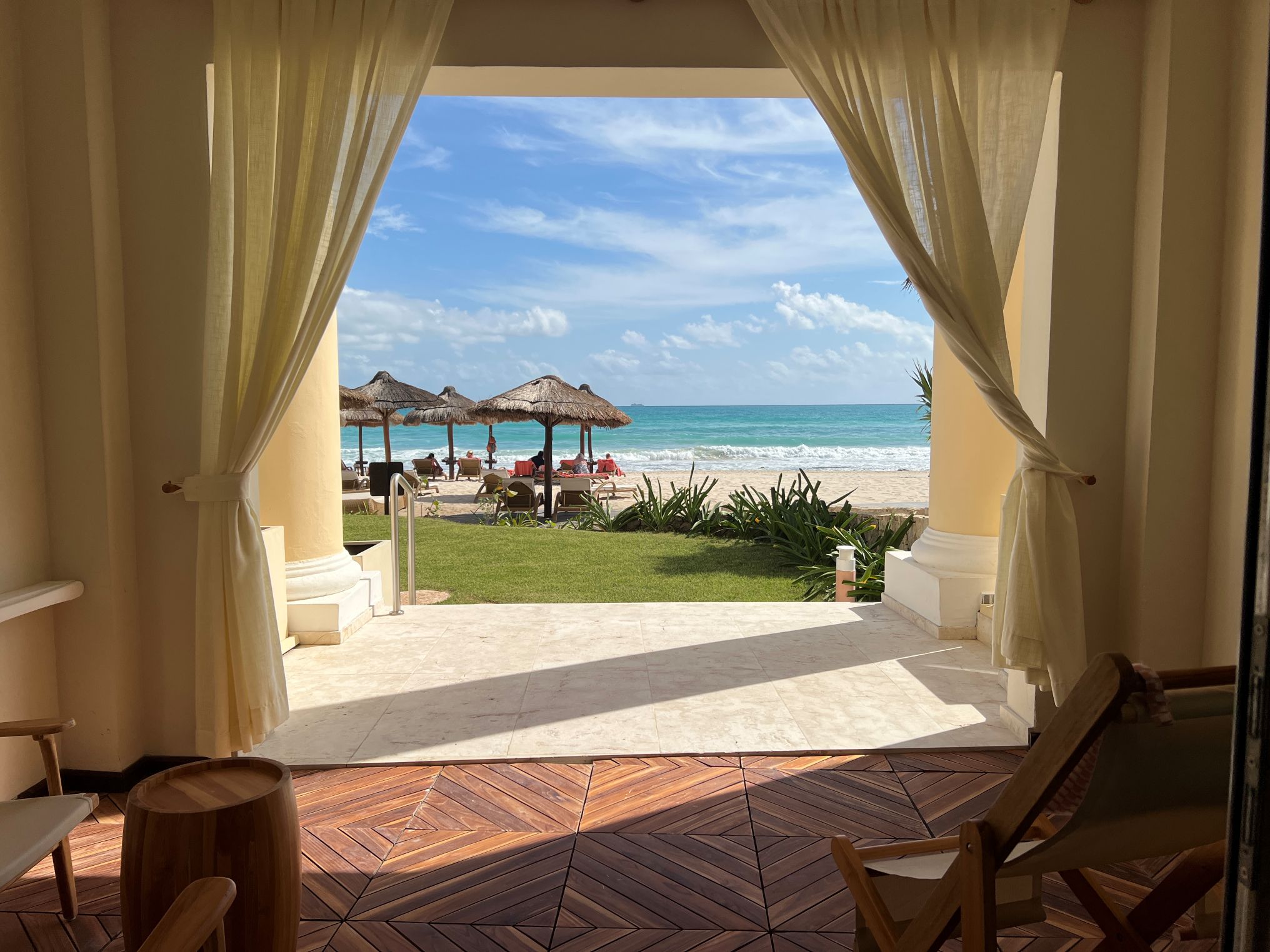
Sometimes the least expensive room is perfectly sensible. Sometimes the room category changes the entire vacation.
First decide how you will use the room.
If you plan to spend most of the day at the beach and return only to shower and sleep, paying substantially more for extra interior space may not add much value. For a honeymoon, anniversary, longer stay, or trip where privacy matters, the view, balcony, bathroom layout, location, and additional space may be worth considerably more.
Pay attention to:
- Actual room size and layout
- Bedding configuration
- Bathroom privacy
- Balcony or terrace
- View type
- Building and floor location
- Distance from the beach, lobby, restaurants, and pools
- Noise from entertainment or service areas
- Stairs and elevator access
- Occupancy limits
- Whether connecting rooms can be requested
- Whether an upgraded category includes meaningful resort privileges
Room names are marketing labels, not universal measurements. “Ocean view,” “oceanfront,” “beachfront,” “swim-up,” and “club level” do not mean precisely the same thing at every resort.
A partial ocean view may involve leaning left and looking past a palm tree. Technically, there is an ocean. Spiritually, you booked the air-conditioning unit.
Is an upgraded club or preferred section worth it?
It depends on what the upgrade actually changes.
An upgraded category may include:
- A separate check-in area
- Access to a private lounge
- Exclusive pools or beach areas
- Additional restaurants
- Better room locations
- Upgraded minibar selections
- Expanded room-service options
- Butler or concierge service
- Added privacy or a calmer atmosphere
At another resort, the upgrade may provide a different pillow menu and a robe with ambitions.
Compare the exact benefits against how you will use the resort. Private beach access may be valuable to someone who wants quieter service and reliable shade. It may mean very little to a traveler who plans to spend every day on excursions.
Pay for an upgrade because it improves something you care about, not because the category name contains three extra adjectives.
How much does the resort’s location matter?
The vacation does not begin when you reach the lobby. The flight and transfer are part of the experience.
A resort farther from the airport may offer the setting, beach, privacy, or atmosphere you want. It may also add a significant transfer after an early flight. That tradeoff can be entirely worthwhile, but it should not be a surprise.
Consider:
- The correct arrival airport
- Approximate private and shared transfer times
- The number of nights you are staying
- Your arrival and departure times
- Whether children or travelers with mobility needs are going
- Whether you plan to take off-property excursions
- Ferry schedules when applicable
- Traffic, construction, and multiple hotel stops
For a three-night escape, losing several hours to transfers matters more than it might on a ten-night honeymoon. Convenience is a form of luxury too. Nobody puts it in the glossy brochure, but getting from the airport to a cold drink before you lose the will to live has value.
Transfer times are estimates and should be verified using the correct airport, resort location, and transportation arrangement.
Are online reviews useful?
Yes ... but use them for patterns, not verdicts.
The overall score rarely tells you whether a resort fits your particular priorities. One traveler gives a resort five stars because the pool party went until midnight. Another gives the same resort one star for exactly the same reason.
Look for repeated, specific comments about:
- Beach and pool conditions
- Resort size and walking
- Noise
- Room maintenance
- Dining waits
- Service consistency
- Accessibility
- Construction
- The difference between room sections
- Transportation within a large resort complex
Check the dates and traveler type. A review from a family during spring break may not predict the experience of a couple traveling in September.
Videos can help you understand scale, room layout, beach width, and how different areas connect. They are especially useful when the resort’s professional photography has developed a complicated relationship with reality.
What should an all-inclusive vacation really cost?
Compare the total trip, not just the advertised room rate.
Depending on the resort and booking, the full cost may include:
- Accommodations
- Flights
- Checked-bag or seat fees
- Airport transfers
- Travel protection
- Upgraded room or club access
- Excursions
- Spa treatments
- Premium dining or beverages
- Tips
- Local or environmental taxes
The cheapest resort is not the best value if the room setup is wrong, the beach does not suit you, or you spend the week paying extra for things you assumed were included.
Likewise, an expensive resort is not automatically luxurious. Luxury may mean more space, thoughtful service, the right location, fewer decisions, a better room layout, or simply not discovering a major mismatch after final payment.
A few resort-trip essentials worth packing

Disclosure: This section contains paid links. As an Amazon Associate I earn from qualifying purchases.
You do not need to arrive with enough equipment to establish a small coastal settlement. A few practical items can make resort travel easier:
- Portable charger for long airport, transfer, excursion, and pool days
- Compact luggage scale for avoiding repacking theater at the airport
- Waterproof phone pouch for pool, beach, and boat days
- Insulated reusable tumbler if the resort permits personal drinkware
- Packable sun hat that does not occupy half the suitcase
Product availability and prices can change. Confirm that any item meets your needs, airline requirements, and resort rules before purchasing or packing it.
When should you use a travel advisor to choose the resort?
You may be comfortable booking on your own if you know the exact resort and room category you want, understand the policies, and are prepared to handle the details and any changes yourself.
Professional guidance becomes more valuable when:
- Several resorts look almost identical
- The trip is a honeymoon, anniversary, destination wedding, or milestone
- Multiple rooms or generations are traveling
- Room layout and location matter
- Accessibility is a concern
- You are comparing upgraded sections or club categories
- The beach, dining, or atmosphere could make or break the trip
- You do not have time to verify every detail
- You want one person who understands the whole trip
Fins Agency does not begin with a giant list of resorts. We begin with the travelers.
We look at who is going, how you want the trip to feel, what matters enough to pay more for, and which compromises you can live with. Then we narrow the field to the resorts and room categories that genuinely fit.
Because “five-star all-inclusive” is not enough information. That is a label, not a recommendation.
Ready to narrow the resort list?
Tell Fins Agency who is traveling, your approximate dates and budget, departure airport, room needs, beach priorities, and the atmosphere you want.
We will help you sort through the look-alike resort photos and focus on the options that fit your actual vacation—not somebody else’s Instagram feed.
Have a question before you begin? Contact Fins Agency